Before Christ: The Man Who Came Before Jesus
Before Jesus had a movement of his own, he went to another preacher to be baptised. What can that relationship tell us about the man behind the religion—and what has the familiar story encouraged us to overlook?
Before Jesus had a movement of his own, he went to another preacher to be baptised. What can that relationship tell us about the man behind the religion—and what has the familiar story encouraged us to overlook?
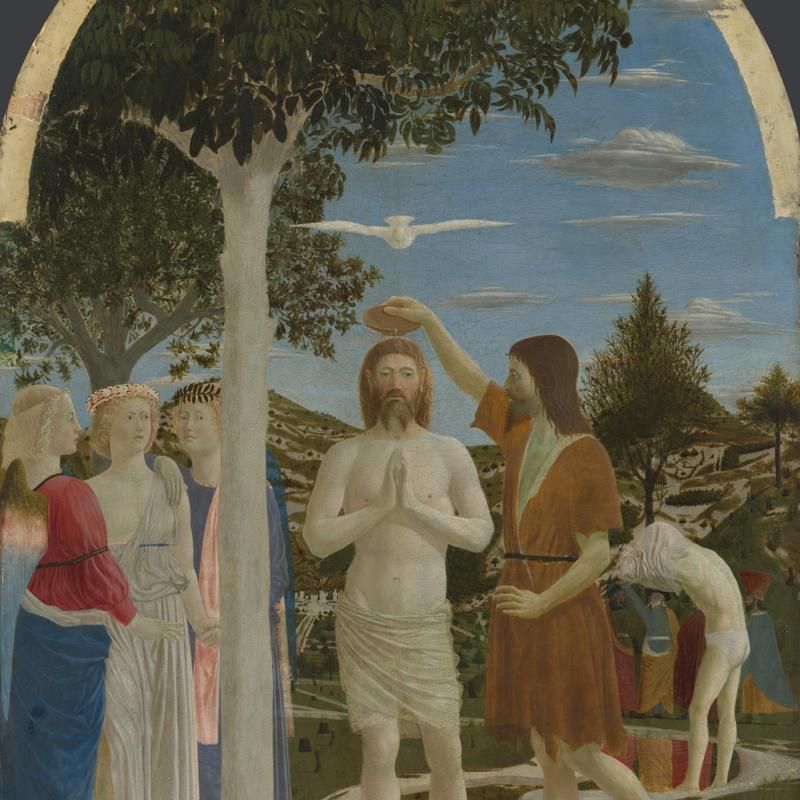
At the beginning of Mark’s account of Jesus’ adult life, something happens that deserves more attention than it usually receives.
Jesus comes from Nazareth to the River Jordan, where another man is already preaching, attracting followers and baptising people. Jesus receives baptism from him. That man is John the Baptist. Bible Gateway
In the Christian story, John’s position is clear: he prepares the way for Jesus. His importance lies partly in recognising the greater figure who follows him.
But that is the relationship as Christianity came to explain it.
What did it look like before the outcome was known?
Perhaps John did not initially think of himself as a supporting character. Perhaps Jesus first approached him because he believed John had something important to teach. Perhaps the relationship developed in ways neither man anticipated.
Those possibilities do not require us to dismiss Christianity or assume a conspiracy. They require something simpler: to stop reading the story backwards.
Before asking how an empire might have changed Christianity, we need to ask what existed before Christianity became an imperial religion.
And before asking what Jesus became, we need to look at where he began.
Jesus lived within a Jewish religious world under Roman supremacy. During his ministry, Judaea was governed by Pontius Pilate, while Galilee was ruled by Herod Antipas. These were different political arrangements within the same wider imperial order—not one uniformly administered territory. Luke’s Gospel itself names these rulers when introducing John’s public activity. USCCB
The language later used about Jesus also belonged to a world that already existed.
Christ was not his surname. It derives from the Greek Christos, corresponding to the Hebrew word behind Messiah: anointed one. The designation could identify someone appointed to exercise authority. In Isaiah 45:1, even Cyrus, the Persian ruler, is described as God’s anointed. The word did not originally mean the unique divine founder of Christianity. USCCB
Calling Messiah a “job title” captures something useful, but it can also mislead. There was no universally agreed vacancy with a fixed job description. Jewish messianic language varied between texts and communities; we should not imagine everyone expecting precisely the same kind of deliverer. Bryn Mawr Classical Review
Nor was Jesus the only figure around whom religious expectations gathered. Josephus describes Theudas, a prophetic leader who, in the 40s CE—after Jesus’ death—persuaded followers to accompany him to the Jordan, promising an extraordinary crossing. Roman troops suppressed the movement and killed him. Josephus calls him a would-be prophet, not explicitly a Messiah. The distinction matters: these figures belonged to a broader landscape of religious expectation, not necessarily to one category of identical claimants. Penelope
But we do not need a long catalogue of rival figures to establish that Jesus entered an existing religious landscape.
John the Baptist is already enough.
A particularly valuable account of John comes from outside the New Testament.
Writing in the late first century, the Jewish historian Josephus describes him as a moral teacher who urged righteous conduct, justice towards others and devotion to God. He explains John’s baptism as a bodily cleansing associated with a life already morally reformed. In this passage, John matters because of his own teaching and influence—not because Josephus identifies him as Jesus’ forerunner. He does not make that connection. Penelope
The Gospels place John within their accounts of Jesus, but they also preserve a figure with a distinct message. Matthew depicts him warning of approaching judgement and demanding conduct that demonstrates repentance. This is not merely a ceremonial welcome for somebody else’s ministry. It is an urgent religious appeal in its own right. USCCB
That gives us a different starting point.
Instead of imagining John as a man whose career existed entirely to introduce Jesus, we can consider him as the centre of a movement that Jesus encountered.
There is an important limitation, however: our surviving accounts are retrospective. Mark is commonly dated around 70 CE, while the Gospel of John is generally placed towards the end of the first century. Both present Jesus through developed religious narratives. They are not correspondence between John and Jesus, or transcripts recorded as their relationship unfolded. USCCB
When I refer to the Gospel of John below, I mean that later Christian text—not a book written by John the Baptist.
The distinction is essential. We possess accounts assigning John a place in Jesus’ story. Recovering how John understood his own place in events is much harder.
The simplest reason to take that possibility seriously is the baptism itself.
In Mark, Jesus receives John’s baptism, which the narrative has associated with repentance and forgiveness. Mark then describes the Spirit descending and a heavenly declaration identifying Jesus as God’s Son. The encounter simultaneously connects Jesus to John’s activity and interprets Jesus as possessing a unique status. Bible Gateway
Historians have often inferred that Jesus was initially a follower of John. In his Yale lecture on the historical Jesus, Dale Martin presents the baptism as evidence pointing towards that relationship. It is a serious historical interpretation, not an idea invented to provoke believers. Open Yale Courses
But the evidence does not tell us how long Jesus remained with John, what instruction he received, or whether their relationship resembled what we would now call formal mentorship.
“Jesus was probably influenced by John and associated with his movement” is stronger than “we know John trained Jesus.”
The Gospel presentations also differ in revealing ways.
Matthew includes an exchange absent from Mark: John initially objects to baptising Jesus, suggesting that their roles should be reversed. Jesus tells him to proceed in order to fulfil righteousness. Matthew therefore addresses the apparent question of hierarchy directly. Why should the greater figure receive baptism from the lesser? USCCB
The Gospel of John takes another approach. It does not narrate the baptism itself. Instead, the Baptist testifies about Jesus, denies that he himself is the Messiah, and directs followers towards him. John’s authority becomes the authority of a witness identifying someone greater. USCCB
It is tempting to see an awkward historical relationship being progressively tidied up.
That may be part of the explanation—but awkwardness is not an automatic test of authenticity. As Nathan Shedd’s survey of the scholarship explains, association with an already prestigious John could also enhance Jesus’ standing. A connection might be useful in one respect and difficult in another. Historians disagree about how heavily to weight those competing considerations. CDAMM
Nor should we imagine Mark preserves an untouched, purely human Jesus before later writers introduced theology. Mark’s own baptism scene already interprets Jesus’ identity.
What the comparison demonstrates is not a simple progression from honest history to invented religion.
It demonstrates that the same relationship could be presented in different ways according to what an author wanted readers to understand.
This is where the idea of a student “outgrowing” his teacher becomes attractive.
Perhaps Jesus began within John’s movement, developed his own ideas and eventually offered something that drew people away from the original preacher.
There are differences in the surviving portraits. Mark describes a dispute in which John’s disciples fast while Jesus’ disciples do not. Jesus responds by comparing his presence among his followers to the presence of a bridegroom: an occasion for celebration rather than mourning. USCCB
Matthew likewise contrasts John’s austere reputation with Jesus’ reputation for eating and drinking. These traditions suggest recognisably different public styles. Bible Gateway
But a neat opposition—John preached fear while Jesus discovered compassion—does not survive much scrutiny.
Luke attributes practical social teaching to John: people should share food and clothing; tax collectors should not demand more than authorised; soldiers should not extort money. His message is not confined to threats about judgement. USCCB
Conversely, Jesus is hardly free of warnings about divine punishment. In the same Matthew chapter that contrasts their lifestyles, Jesus condemns towns that have not responded to his activity and invokes the coming judgement. Bible Gateway
Dale Allison makes a valuable methodological objection in The Continuity between John and Jesus. We possess far less material about John than about Jesus. That imbalance makes it hazardous to assume that something absent from John’s surviving portrait was absent from his actual teaching. Allison argues for taking continuity seriously, rather than reconstructing Jesus chiefly by making him John’s opposite. Academia
That changes the question.
Rather than asking whether Jesus discarded John’s message, we might ask how he developed it.
A follower can retain a teacher’s central convictions while changing the emphasis, widening the audience or adopting a different manner of life. Independence does not necessarily mean rejection.
And “outgrew” is ultimately a judgement about whose version was better. The historical question is whether their movements diverged—not whether the eventual success of Christianity proves that Jesus had surpassed his teacher.
The Gospel of John offers an intriguing scene.
John and Jesus are associated with baptising activity at the same time. Some of John’s followers complain that people are going to Jesus. The narrative then has John welcome the change, presenting his own diminishing role as appropriate. A clarification in the following chapter says that Jesus’ disciples, rather than Jesus personally, performed the baptisms. USCCB
This can be read as a gracious transfer of authority.
It can also be read as a Christian answer to a question that might once have been uncomfortable: why should people loyal to John accept Jesus instead?
Historian Joel Marcus argues that rivalry between the movements helps explain the strong insistence on John’s subordinate position. In his own discussion of his research, Marcus suggests that the historical John may have understood his own ministry as central, rather than already recognising Jesus in the way later Christians did. That is a reconstruction, not a surviving confession from John. The Bart Ehrman Blog
There is also a trap here. We cannot treat the followers’ complaint as transparent historical evidence while dismissing John’s accommodating response merely because it does not suit a rivalry theory. Both belong to the same authored narrative.
The possibility of competition is worth investigating. A documented personal feud is another matter.
Then comes the exchange that most complicates the familiar picture.
In Matthew 11 and Luke 7, the imprisoned John sends followers to ask whether Jesus is the expected coming figure, or whether they should look for somebody else. Jesus answers by pointing to healings and good news reaching the poor. Bible Gateway
The question sounds like uncertainty.
Perhaps John expected judgement to arrive more dramatically. Perhaps reports about Jesus did not match his expectations. Perhaps the exchange primarily serves the Gospel writers’ purpose of explaining Jesus’ identity.
Marcus takes the question seriously as evidence against assuming John had always confidently recognised Jesus as Messiah. But it cannot settle exactly what John thought—or whether the conversation occurred in precisely the form preserved. The Bart Ehrman Blog
Crucially, the accounts do not give us John’s response to Jesus’ answer. We do not learn that he was satisfied, offended, reassured or unconvinced. Luke instead moves to Jesus praising John before the crowd. USCCB
That absence is not permission to write whichever ending we prefer.
It is where the evidence stops.
The later narrative in Acts also depicts people who know John’s baptism and subsequently receive instruction and baptism associated with Jesus. It suggests that John’s legacy did not simply vanish into Christianity in one seamless handover. It does not establish the size, organisation or beliefs of every group connected with him. Bible Gateway
John was executed under Herod Antipas, but the surviving sources emphasise different reasons.
Josephus presents a political calculation: Antipas feared that John’s influence over the population could develop into rebellion. In this account, John is imprisoned at Machaerus and killed before that perceived threat can materialise. Josephus is an independent literary witness, not an eyewitness report of the decision. Penelope
Mark gives a more elaborate story involving John’s criticism of Antipas’s marriage, Herodias’s hostility, a banquet and a request for John’s head. Its account places the execution within a conflict over conduct and royal resentment. USCCB
Political anxiety and personal hostility could coexist. Nevertheless, compatibility is not proof that every element belongs to one recoverable sequence.
For our question, the important point is what these accounts do not establish.
They do not provide a final conversation in which John accuses Jesus of abandoning his teachings. They do not document reconciliation after a quarrel. Nor do they reveal whether Jesus privately experienced John’s death chiefly as grief, warning, confirmation of his mission—or some combination of these.
It is reasonable to wonder what the killing of an influential predecessor meant to him.
It is not reasonable to present an imagined answer as recovered history.
Another passage makes the historical Jesus feel less distant—and requires more care than it often receives.
In Mark 3, a crowd gathers around Jesus so intensely that he and those with him cannot eat. People identified in many translations as his family go to restrain or take charge of him. The explanation involves the allegation that he has lost his mind. Bible Gateway
It sounds like striking evidence that his family believed something had gone seriously wrong.
But the translations differ over who is making that allegation.
The New International Version attributes the statement to “they”, naturally connecting it with the family’s intervention. The New Revised Standard Version Updated Edition instead says “people were saying”, allowing the family to be responding to what others were saying about him. Bible Gateway
That difference matters.
The safest summary is not that we possess an unequivocal report of Jesus’ mother declaring him insane. We have a passage portraying intervention by people close to him amid allegations that he was behaving irrationally.
Later in the chapter, his mother and brothers arrive and call for him. Jesus responds by identifying those who do God’s will as his family. Mark’s narrative brings biological kinship into tension with the new community around him. Bible Gateway
This is also part of Mark’s wider presentation of people struggling to understand Jesus. The passage does literary and theological work; its uncomfortable quality does not automatically make it an unfiltered family recollection. USCCB
The Gospel of John is more direct about another point: it states that Jesus’ brothers did not believe in him at the stage of the story described in chapter 7. That supports discussing traditions of family scepticism, while remaining a claim made by a Gospel author. USCCB
Yet “his family rejected him” would still be too simple.
Paul, writing about his own contacts with the early movement, says he met James, whom he identifies as Jesus’ brother. Elsewhere in Galatians, James appears among the recognised leaders of the Jerusalem community. Whatever the history of individual relatives’ attitudes, Jesus’ family cannot be treated as permanently and uniformly outside the movement. USCCB
We cannot confidently reconstruct how James reached that position from these passages. Nor can we assume he was personally involved in every earlier family incident.
But the complication is valuable. The sources preserve neither universal family acceptance nor a simple story of permanent rejection.
This is the more speculative question behind the family passages.
Suppose someone joins a religious movement, develops an independent public role and finds that people increasingly regard him as important.
Could that attention affect his understanding of his own mission?
Of course it could. But that is a possibility about human behaviour, not evidence that this particular sequence happened inside Jesus’ mind.
The distinction becomes especially important with the word arrogance.
Confidence, conviction, perceived religious obligation and arrogance can produce behaviour that looks similar from the outside. A family’s concern does not establish which explanation applies. Neither does the existence of devoted followers.
I am interested in the possibility that Jesus’ understanding of his role developed, rather than arriving fully formed. But it would be too easy to replace a theological certainty—he knew everything from the beginning—with an equally unsupported psychological certainty—success went to his head.
The historical question should remain open without becoming an invitation to diagnose him.
Taking Jesus seriously as a human historical figure means allowing for development, uncertainty and relationships.
It also means accepting that we cannot recover all of them.
Where does that leave the idea that Jesus began as John’s follower and eventually moved beyond him?
With a substantial starting point, but an incomplete biography.
The baptism is a strong basis for investigating John’s influence. The surviving traditions distinguish their practices and portray separate circles of followers. They also contain both affirmation and uncertainty about Jesus’ relationship to John. None of this establishes the neat sequence of apprenticeship, rebellion and estrangement that a modern storyteller might want. Open Yale Courses
More fundamentally, the sources invite us to distinguish John’s historical importance from the particular role Christianity assigned him.
The Gospel of John makes him a witness to Jesus. Josephus remembers him as a consequential religious figure without explaining his significance through Jesus at all. Those are different portraits, shaped by different authors’ interests. USCCB
That is not evidence that Rome secretly rewrote their relationship. The interpretive process we are examining is already visible in early Christian literature, long before the imperial councils that come later in this investigation.
It does, however, suggest a question worth carrying forward.
When a movement survives, it preserves the people who preceded it within the story of its own success. Their importance can become inseparable from where that surviving story eventually leads.
But John did not live in a world where Christianity’s future was already visible.
Neither did the people encountering Jesus before his death.
Before we ask whether Jesus outgrew John, we should ask whether we have allowed John to exist outside Jesus’ story at all.
And before we ask how Rome transformed Christianity, we need to follow the movement through the event that could have ended it: the execution of Jesus himself.
That is where the next part begins.
Biblical citations above establish what the surviving texts say; they do not independently verify every event described. Passage numbers are included so that readers can examine the wording and its context.
Josephus, Jewish Antiquities 18.116–119 and 20.97–99. The principal non-Christian account of John’s teaching and execution, and the account of Theudas. The linked texts use William Whiston’s translation, hosted by the University of Chicago. Penelope
Dale C. Allison Jr., “The Continuity between John and Jesus,” Journal for the Study of the Historical Jesus 1, no. 1 (2003), pp. 6–27. A substantial challenge to reconstructions that exaggerate the contrast between the two men. Academia
Joel Marcus, author’s discussion of John the Baptist in History and Theology (2019). The accessible author discussion, rather than the full book, was consulted for his interpretation of John’s self-understanding and possible competition between the movements. The Bart Ehrman Blog
Nathan Shedd, “John the Baptist,” Critical Dictionary of Apocalyptic and Millenarian Movements (2021). A survey of the evidence, its limitations and competing scholarly reconstructions. CDAMM
Dale B. Martin, “The Historical Jesus,” Open Yale Courses, Lecture 13. Discussion of historical method and the inference that Jesus began as a follower of John. Open Yale Courses
D. Clint Burnett, review of Matthew V. Novenson’s The Grammar of Messianism, Bryn Mawr Classical Review 2019.09.60. Consulted for discussion of why ancient messianic language should not be reduced to one fixed expectation.