The Bible That Didn't Exist Yet
The earliest Christians did not inherit a finished New Testament. They inherited traditions, letters, competing interpretations and a question that became increasingly consequential: who had the authority to speak for Jesus?
The earliest Christians did not inherit a finished New Testament. They inherited traditions, letters, competing interpretations and a question that became increasingly consequential: who had the authority to speak for Jesus?
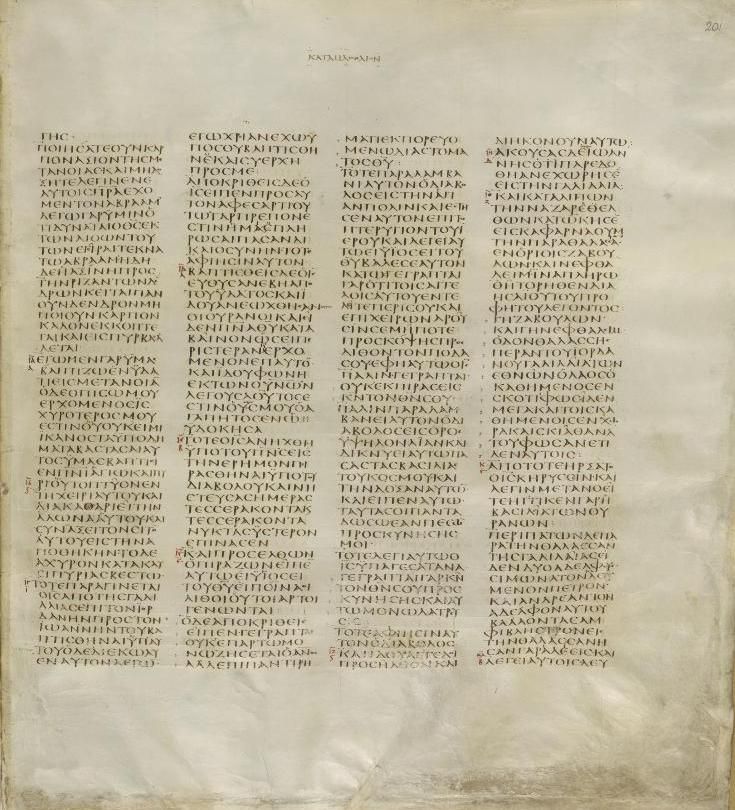
One of the most revealing things about an ancient Bible is what happens when you keep turning its pages.
Codex Sinaiticus, copied in the fourth century, contains the twenty-seven books familiar from the modern New Testament. But it also contains two other Christian works: the Epistle of Barnabas and the Shepherd of Hermas. These were preserved in the same manuscript, although they would not become part of the standard New Testament collection. Codex Sinaiticus
Their presence does not prove that everyone involved regarded every included work as equally authoritative. A manuscript’s contents and a universally accepted definition of scripture are not the same thing.
Nevertheless, here is physical evidence of a Christian book whose boundaries do not correspond neatly to the Bible many readers now take for granted.
That changes the question.
Instead of beginning by asking which books were removed from an original, complete Bible, we need to ask how particular writings became a Bible in the first place.
The distinction does not make questions about power disappear.
It brings them into sharper focus.
Who decided which accounts could define Jesus—and which accounts would remain outside the collection through which most people would encounter him?
The first Christians were not without scripture. Their movement emerged within Judaism, and Jewish sacred writings supplied language through which they interpreted Jesus. What they did not possess was a finished Christian New Testament. Its writings were still being composed, circulated and collected. Open Yale Courses
Paul’s letters, generally dated to the 50s CE, are among the earliest surviving examples. They were communications with particular communities, not chapters written to occupy predetermined places in a future book. Open Yale Courses
Read them as correspondence and something becomes apparent: the movement was already arguing.
In Galatians, Paul describes confronting Peter over his withdrawal from meals with Gentile believers. This is Paul’s account of the disagreement, not a neutral transcript, but it preserves an uncomfortable fact about how Paul wanted his readers to understand events. Prominent figures within the movement could disagree about what fidelity to Jesus required. Bible Gateway
There is a complication here for any theory that imagines an entirely simple, human Jesus being transformed into a divine figure only centuries later. Philippians 2 already presents Jesus in exalted language, connecting him with divine status, self-emptying, obedience and universal acknowledgement. Precisely how to interpret that passage remains debated, but its extraordinary claims belong to early Christian writing, not merely to imperial theology. Bible Gateway
Christianity was developing before Roman emperors became its patrons.
That matters because we should not assign every transformation to the same cause.
The movement Rome eventually encountered had already spent generations explaining Jesus, disputing his significance and negotiating who belonged.
The Gospels came later than Paul’s earliest surviving letters. Mark is commonly dated around 70 CE, with Matthew and Luke generally understood to have used Mark alongside other material. The exact relationships between their sources remain subjects of scholarship, but the basic point is that these accounts emerged through a process of composition. Open Yale Courses
Luke makes that process unusually visible.
His opening acknowledges previous attempts to construct narratives, traditions transmitted by earlier witnesses, and his own decision to produce an orderly account. He does not present his book as something appearing without predecessors or editorial work. Bible Gateway
That leaves us with a more interesting picture than either perfect mechanical preservation or a hopeless game of Chinese whispers.
The question is what particular authors received, selected and arranged.
Consider two versions of a familiar teaching. Matthew’s Jesus blesses the “poor in spirit”; Luke’s Jesus addresses “you who are poor”. Those formulations direct attention differently, even though neither passage by itself tells us precisely how the difference arose. Bible Gateway
Perhaps differing traditions were inherited. Perhaps an author clarified an emphasis. Perhaps similar teachings had been delivered in different settings.
What we cannot do is silently combine the accounts and then forget that we performed the combination.
Nor should we assume every difference demonstrates deception. An author could sincerely believe that arranging or explaining a tradition helped communicate its meaning.
But sincerity does not eliminate interpretation.
The Gospels preserve traditions about Jesus through the work of people who already believed those traditions meant something.
That is the first kind of shaping we need to distinguish from the later selection of biblical books.
By the second century, Christians could disagree not only about particular teachings but about which writings should govern the faith.
Marcion is an especially revealing example.
His opponents describe a teacher who distinguished the creator associated with Jewish scripture from the Father revealed by Jesus. His collection centred on a Gospel closely related to Luke and ten Pauline letters. This was a radically different scriptural arrangement from a Christian Bible joining Jewish scripture to four Gospels and a wider collection of apostolic writings. New Advent
Writers such as Tertullian accused Marcion of cutting and altering texts. Those accusations are important evidence, but they come from an adversary arguing that Marcion’s version was illegitimate. They should not be mistaken for an impartial report in which every disputed textual relationship has already been settled. New Advent
The larger point is difficult to avoid.
Choosing a collection of scripture could itself express a theology. What belonged in the collection helped determine which story Christianity told about God, Israel and Jesus.
The struggle over books was also a struggle over the religion they could sustain.
The phrase lost Gospels can encourage an enticing assumption: somewhere beneath the familiar story lies an older, purer version that the authorities buried.
Some excluded writings may preserve early traditions. Others reflect later developments. Their titles do not establish authorship, and exclusion does not automatically make a text either fraudulent or authentic.
They need to be examined individually.
The Gospel of Thomas is a collection of 114 sayings attributed to Jesus. It does not provide the familiar continuous narrative of ministry, arrest, crucifixion and resurrection. Its opening connects the interpretation of Jesus’ sayings with overcoming death, while other sayings locate the kingdom in ways that challenge the expectation that it must arrive as an easily observable external event. Gospels.net
This is recognisably a different presentation of what matters about Jesus.
But the absence of a resurrection narrative does not establish that its author denied resurrection. A sayings collection is not attempting everything a narrative Gospel attempts.
Dating introduces another complication. Dale Martin’s Yale discussion places Thomas within a scholarly debate: many date its composition to the second century, while some argue for earlier material or an earlier collection. An individual saying could also preserve an older tradition without making the entire surviving work earlier than Mark. Open Yale Courses
The manuscript dates must be kept separate again. The complete Coptic version survives in a much later copy, while Greek fragments demonstrate earlier circulation. The age of the physical manuscript is not automatically the age of the work it preserves. Gospels.net
Thomas therefore offers evidence for another way of presenting Jesus’ authority.
It does not provide a shortcut around the historical problems affecting every ancient account.
The Gospel of Mary approaches authority more directly.
After the Saviour’s departure, the disciples are distressed. Mary reassures them and recounts teaching received through a vision. Andrew questions the teaching; Peter challenges the idea that the Saviour spoke privately to a woman rather than openly to them. Levi defends her. Gospels.net
The dispute is not merely about whether Mary remembers a sentence correctly.
It concerns whose experience is credible and whether familiar claims to leadership can be challenged by someone possessing a different kind of authority.
Karen King generally dates the work to the second century and identifies its Mary with Mary Magdalene, although the surviving text calls her simply Mary. It is not a document whose title establishes that Mary herself wrote it. Early Christian Texts
Nor does its dialogue independently prove that the historical Peter and Mary had this exact confrontation.
It does demonstrate that a Christian author could imagine Jesus’ teaching being preserved by a woman whose male colleagues struggled to accept her authority.
The principal manuscript is also badly incomplete: its opening pages and a substantial middle section are missing. That damage limits interpretation, but missing pages are not, by themselves, evidence that a censor deliberately removed their contents. Gospels.net
Here the uncertainty is part of the evidence, not something we should repair with a satisfying story.
The Gospel of Judas overturns expectations in another way.
Its Jesus laughs at the disciples’ religious misunderstanding, challenges their worship and discloses elaborate mysteries to Judas. The text places severe criticism of the disciples into Jesus’ own mouth. Whatever else it means, it contests the assumption that the recognised apostolic group necessarily understood him. Gospels.net
Yet the popular description of Judas as the secret hero is too simple.
April DeConick has argued against that interpretation, maintaining that Judas remains a negative, even demonic figure within the work. The disagreement illustrates how much can depend on translation, damaged passages and the interpretation of an unfamiliar religious system. The People of Rice | Rice University
There is also evidence that the title was known long before its modern recovery: Irenaeus mentions a Gospel of Judas while condemning rival teachings in the second century. The surviving text comes from Codex Tchacos, not the Nag Hammadi collection. New Advent
The text is valuable even without turning it into Judas’s personal testimony.
It reveals another Christian argument about who understood Jesus—and who was leading people astray in his name.
Then there is the writing that makes the question of excluded material especially uncomfortable.
The Infancy Gospel of Thomas is not the sayings collection discussed above. It is a separate work, usually dated to the second century, containing stories about Jesus between the ages of five and twelve.
In one episode, another child bumps into him and dies following his curse. Other scenes involve punishment, confrontations with teachers and displays of knowledge that adults cannot match. These are not the childhood stories most people encounter in church. tonyburke.ca
The collection also contains healing, restoration and other miracles. Reducing it to a sequence of acts of cruelty would misrepresent its contents, although that does not make its disturbing episodes disappear. nasscal.com
It would be tempting to say this is the dangerous truth about Jesus that Christianity concealed.
But the text’s existence cannot establish that these events happened. It gives us evidence of stories Christians told about Jesus’ childhood, not direct access to that childhood.
Scholar Christopher Frilingos argues that infancy narratives deserve attention beyond their capacity to shock: they also explore family relationships and the difficulty of living with a child whose identity exceeds the understanding of those around him. ANCIENT JEW REVIEW
Most importantly for our investigation, these stories did not simply vanish. Tony Burke documents their extensive transmission in multiple languages across the centuries. tonyburke.ca
A text could remain outside the Bible and still remain inside Christian culture.
That complicates any account in which exclusion automatically meant eradication.
The recovery of the Nag Hammadi writings in Egypt, conventionally dated to 1945, transformed access to ancient religious literature. The collection includes Coptic manuscripts, mostly copied in the fourth century, preserving works whose composition often belongs to earlier periods. Thomas is among them. Cambridge University Press
These discoveries made it possible to read substantial writings rather than depend entirely on descriptions supplied by people attacking them.
But the collection was not an original New Testament with its missing chapters restored.
Nor did every famous non-canonical Gospel come from the same discovery. Mary survives through a different manuscript history, and Judas through Codex Tchacos. Gospels.net
The reason the Nag Hammadi books were buried also remains uncertain.
A familiar explanation links their concealment to fourth-century efforts to enforce approved scripture. That is a historical hypothesis, not an established chain of events. Paul Linjamaa’s research examines competing accounts of the manuscripts’ owners and argues for monastic readers; Mark Goodacre has separately questioned the reliability of details in the widely repeated discovery story. Cambridge University Press
We should therefore resist replacing one unquestioned narrative with another.
The manuscripts are real. Their importance is real.
A confident story about precisely who hid them, under which threat and on whose orders requires evidence the surviving books cannot supply by themselves.
So far, we have been considering different works and different collections.
There is another history inside the manuscripts themselves.
Codex Sinaiticus contains extensive corrections made by different hands over time. Its physical pages preserve evidence of readers and scribes working on the text rather than simply transmitting an untouched object. Codex Sinaiticus
A correction does not automatically mean theological manipulation. It might repair an error or bring a copy into agreement with another manuscript. Conversely, it would be equally mistaken to assume every alteration was accidental.
The evidence must be assessed passage by passage.
Mark’s longer ending, now numbered 16:9–20, is absent from important ancient witnesses, while other manuscripts preserve different endings. Modern editions commonly identify this textual problem. Bible Gateway
The issue is not whether Mark originally contained any resurrection belief. Before the disputed ending, the women are already told that Jesus has risen.
The issue is the additional narrative: appearances, commissioning and signs associated with believers.
There is an especially revealing chronological detail. Irenaeus quotes wording from Mark 16:19 in the second century. The longer ending was therefore already circulating long before Constantine. New Advent
That establishes something more precise than either “the Bible never changed” or “Roman emperors added the resurrection”.
A passage can be secondary to a Gospel’s earliest recoverable form and still be very ancient.
The story now usually placed at John 7:53–8:11 presents a similar problem.
Important early witnesses omit it, and other manuscripts place it elsewhere—including, in some cases, within Luke. The instability of its location is part of the evidence that it did not originally occupy its familiar place in John. Bible Gateway
That does not, by itself, determine when the story first arose or whether anything resembling its events happened.
It establishes a problem in the history of the text.
This distinction matters throughout the investigation. Reconstructing the earliest available wording of a Gospel and establishing the historical truth of the events it describes are different tasks.
And neither should be confused with deciding whether that Gospel belongs in scripture.
Composing an account, altering a manuscript and defining a canon are three different processes. They can interact without becoming one coordinated operation.
By the middle of the second century, Justin Martyr describes Christian gatherings in which the memoirs of the apostles and writings of the prophets are read aloud. Sacred authority was being exercised through communal practice, not only through lists of approved titles. New Advent
A work repeatedly heard, taught and explained could become part of how a community understood its faith.
Irenaeus makes the boundary more explicit. Around the end of the second century, he insists on four Gospels and supports that number through comparisons with the world’s four regions and winds. To modern ears, that is an unusual way to defend a collection. It is a theological argument about fittingness, not a modern investigation into documentary reliability. New Advent
But it would be misleading to imagine him choosing four books from scratch because he liked the number.
In the same discussion, he describes opponents making use of Gospels he accepts. The conflict was not always between one group possessing the familiar books and another possessing entirely different ones. Christians could read overlapping texts and reach incompatible conclusions. New Advent
This is where controlling the collection and controlling its interpretation begin to overlap.
Tertullian’s argument against Marcion appeals to apostolic authority and continuity of teaching. For him, a text’s legitimacy cannot be separated from its relationship to the faith he believes the apostles transmitted. New Advent
There is an understandable logic here: preserve what genuinely comes from the founders.
There is also a potential circle: the accepted faith helps identify authentic writings, while accepted writings help define the faith.
A community can operate within that circle sincerely.
It can also become increasingly difficult for an alternative account to gain a hearing.
The boundaries were still not identical everywhere.
In the early fourth century, Eusebius distinguishes recognised writings from disputed ones. James, Jude, 2 Peter and 2 and 3 John appear among texts whose standing remained contested. His handling of Revelation acknowledges disagreement too. He also identifies other writings as rejected or heretical rather than placing every non-canonical work into one undifferentiated category. New Advent
The modern contents page can obscure those distinctions. A reader encountering James and John within the same printed volume would not automatically know that their reception histories differed.
In his Festal Letter of 367, Athanasius lists the twenty-seven New Testament books familiar today. But he makes a further distinction that is particularly valuable here: some writings outside his canon, including the Didache and the Shepherd of Hermas, can still be used for instruction. New Advent
This is not a simple division between authorised truth and books that must disappear.
There could be scripture, useful religious reading and condemned teaching.
The Shepherd therefore helps make sense of the manuscript with which we began. Its presence in Codex Sinaiticus is not evidence of a secret book later discovered behind a conspiracy. It is evidence of a Christian literary world whose categories do not map neatly onto a modern Bible’s binding. Codex Sinaiticus
The canon was becoming more clearly defined.
That is different from saying a single decision had always governed everyone.
There is something intuitively plausible about the suggestion that the more extraordinary or embarrassing stories were excluded.
The punitive childhood Jesus certainly complicates the familiar portrait.
But “too strange” cannot explain the boundary on its own. Revelation remained inside the eventual New Testament despite imagery including a seven-headed dragon, a woman clothed with the sun and warfare in heaven. Bible Gateway
The difference is not that one collection contains supernatural material while the other does not.
What mattered to authorities such as Eusebius included claims of apostolic connection, established use and agreement with accepted teaching. Those judgements might reject a text modern readers found relatively attractive while retaining one they found deeply unsettling. New Advent
That means we should ask a more specific question than whether the wilder stories were removed.
Which portrayals of Jesus were considered legitimate—and what standards gave certain authorities the power to decide?
The answers may reveal institutional interests. They may also reveal genuine attempts to preserve a tradition against material believed to be recent or misleading.
Those possibilities are not mutually exclusive.
The surviving record is incomplete in ways the Bible itself occasionally exposes.
In 1 Corinthians 5:9, Paul refers to a previous letter. Whatever happened to that earlier correspondence, the passage reminds us that the title First Corinthians does not mean Paul’s first-ever communication with that community. The surviving collection is not a complete record of everything he wrote. Bible Gateway
But the reference gives us no basis for assigning the earlier letter’s fate to a Roman censor.
The same restraint is necessary with other losses.
Where we have an order to destroy a book, we can investigate deliberate suppression. Where we have only absence, several explanations remain possible.
There is nevertheless a quieter mechanism worth considering.
A book does not have to be publicly burned to lose its influence. Suppose it ceases to be read in worship, no longer informs teaching and is no longer treated as worth reproducing. Its future becomes very different from that of a work copied and explained as scripture.
That is an inference about how preservation can become selective, not proof of what happened to every missing document.
It also shows why the choice need not be between complete innocence and an organised conspiracy.
Sincere decisions about which books deserve attention can have lasting consequences for which voices remain audible.
Later readers may inherit those consequences without encountering the arguments that produced them.
It would be a mistake to finish by imagining that the excluded writings collectively reveal the real Jesus, while the canonical writings reveal only the institution.
The evidence does not divide so conveniently.
Some non-canonical works are later than the familiar Gospels. Some may preserve earlier traditions. A text can illuminate the beliefs of its author and readers without supplying reliable information about the historical Jesus. Thomas’s disputed dating alone should discourage a blanket judgement about everything outside the canon. Open Yale Courses
Nor should the preservation of several Gospels be treated only as an act of narrowing. It also preserved differences rather than replacing them with one completely harmonised narrative.
What emerges is a history of both conservation and selection.
Christians transmitted material they believed mattered. They also argued about what mattered most, what came from legitimate authority and what threatened the faith they believed they had received.
The alternative writings show how differently Jesus could be presented. The manuscripts show that textual transmission was not motionless. The early lists show that the boundaries of scripture required definition.
Together, they challenge the assumption that the Bible arrived as a finished book whose contents and wording stood outside history.
They do not establish that every rejected voice was older, truer or deliberately silenced by Rome.
The question I keep returning to is narrower—and, I think, harder to dismiss.
When a religious institution determines which writings can speak with sacred authority, it also helps determine which versions of its founder future generations are most likely to encounter.
That power existed before imperial Christianity. Irenaeus and Tertullian were already arguing over legitimate texts and interpretations long before the councils and emperors that dominate the familiar popular story. New Advent
But persuasion, communal exclusion and imperial enforcement are not the same thing.
The next question is what happened when these disputes became entangled with the authority of the Roman state.
Not when Rome invented a religion.
When rulers acquired a stake in which version of an existing religion would prevail.
What changes when the people deciding which voices count gain the power not only to argue against alternatives, but to punish them?
That is where the next part begins.
Manuscript evidence. The Codex Sinaiticus Project’s sections on the manuscript’s content, date and significance document its fourth-century production, inclusion of Barnabas and the Shepherd, and extensive corrections. Physical inclusion is distinguished here from universally recognised canonical status. Codex Sinaiticus
Biblical passages and textual notes. The principal passages examined are Luke 1:1–4; Galatians 2:11–14; Philippians 2:6–11; Matthew 5:3; Luke 6:20; 1 Corinthians 5:9; Mark 16; John 7:53–8:11; and Revelation 12. The NRSVUE notes identify significant manuscript differences in Mark and John. Bible Gateway
Early arguments about scripture. Primary sources include Justin Martyr, First Apology 67; Irenaeus, Against Heresies 1.27, 1.31, 3.10.5 and 3.11; Tertullian, Against Marcion, Book 4; Eusebius, Church History 3.25; and Athanasius, Festal Letter 39, especially sections 5–7. These writers’ descriptions of opponents are treated as partisan testimony, not neutral adjudications. New Advent
Non-canonical writings. Mark M. Mattison’s accessible translations of Thomas, Mary and Judas were consulted alongside the accompanying manuscript information. Dating and interpretation draw on Dale Martin’s Yale lectures, Karen King’s discussion of Mary, April DeConick’s interpretation of Judas, and Tony Burke’s research on the Infancy Gospel of Thomas. Gospels.net
Nag Hammadi and the limits of reconstruction. Paul Linjamaa, The Nag Hammadi Codices and their Ancient Readers (2024), particularly its introductory discussion of ownership and interpretation; and Mark Goodacre, “How Reliable Is the Story of the Nag Hammadi Discovery?”, Journal for the Study of the New Testament 35.4 (2013), pp. 303–322. Their arguments caution against treating a proposed discovery or concealment narrative as established fact.