The Empire That Chose Christianity
Christianity did not begin as a Roman invention. But when emperors acquired a stake in its success, they also acquired a stake in deciding which Christianity would succeed.
Christianity did not begin as a Roman invention. But when emperors acquired a stake in its success, they also acquired a stake in deciding which Christianity would succeed.

In 303 CE, imperial persecution brought orders to destroy Christian churches and burn their scriptures. Eusebius, writing about events within his own lifetime, records the assault on the movement’s buildings, books and standing in society. New Advent
Within the following generation, Constantine ordered the destruction of writings by another Christian: Arius. Concealing those writings could, according to the surviving edict, carry the death penalty. fourthcentury.com
The contrast is extraordinary.
The state had moved from attacking Christian literature to intervening in the question of which Christian literature deserved to exist.
That is the transformation at the centre of this investigation.
Not the invention of Jesus. Not a secret meeting at which Roman officials fabricated Christianity from nothing.
Something more historically visible: an existing religion acquiring imperial patronage, while emperors and church leaders increasingly worked together to determine which interpretations possessed legitimate authority.
The distinction matters because we do not need to imagine a coordinated deception to recognise the power involved.
A state does not have to invent a belief to influence which version of it future generations inherit.
The agreement associated with Constantine and Licinius at Milan in 313 did not announce that everyone must become Christian.
The surviving document, preserved by Lactantius, grants Christians—and others—freedom to follow their chosen religion. It also orders the restoration of Christian property. Its stated reasoning connects religious freedom with securing divine favour for the rulers and the population they govern. New Advent
That is already revealing.
Religion was not being treated simply as a private opinion unrelated to government. Relations with the divine were understood as consequential for public welfare.
But allowing a religion to exist and actively favouring particular representatives of it are different things.
Eusebius preserves a letter in which Constantine directs public money to Caecilian, bishop of Carthage, for distribution among recognised clergy. Another exempts clergy associated with Caecilian’s church from public duties so that they can devote themselves to religious service. The justification again connects their worship with benefits to the state. New Advent
These are concrete instruments of influence.
Money. Privileges. Recognition of particular leaders.
Consider the difference between two religious communities, each convinced that it preserves the authentic faith. One receives official support; the other is treated as a disruptive rival.
Even without changing a sentence of scripture, that difference could alter their capacity to organise, teach and survive.
Patronage is not the same thing as censorship. But it helps establish the conditions under which some voices become more authoritative than others.
This is the point at which it becomes tempting to choose between two familiar portraits.
Constantine the sincere convert.
Or Constantine the calculating politician, using religion to govern.
The surviving documents make that opposition look too simple.
In a letter addressed to Alexander and Arius during their theological dispute, Constantine connects religious agreement with the restoration of public order. He presents harmony concerning the divine and the health of the wider world as related objectives. He also expresses impatience with the controversy dividing them. The letter survives in Eusebius’s admiring Life of Constantine, so it gives us an imperial self-presentation transmitted by a sympathetic author—not unrestricted access to the emperor’s thoughts. New Advent
Nevertheless, the political concern is explicit.
We do not have to infer that Constantine wanted religious unity entirely from his subsequent actions. His correspondence says so.
What we cannot establish is that he privately considered Christianity false and promoted it regardless.
Nor is that stronger accusation necessary.
A ruler who genuinely believes God grants victory may regard religious unity as both a spiritual obligation and a political necessity. Supporting the correct worship could seem simultaneously pious and advantageous.
That combination might make intervention more determined, not less.
The historical issue is not whether Constantine had to stop believing before he could use Christianity. It is what happened when his understanding of good government became entangled with his understanding of religious truth.
The Council of Nicaea in 325 is frequently imagined as the moment Christianity was assembled into its recognisable form.
The actual dispute was more specific.
The council’s creed affirmed that the Son was begotten rather than made and shared the Father’s substance. It rejected formulations implying that the Son had once not existed or belonged to the order of created things. These were arguments about how Jesus’ divine status should be understood, not a first-time vote on whether an otherwise ordinary human should become a god. New Advent
Even Arius’s position should not be reduced to “Jesus was just a man”. A profession of faith attributed to him and preserved by Socrates describes a divine Word existing before the ages and involved in creation. The disagreement concerned the relationship between that Son and the Father. New Advent
To a modern reader, such distinctions can seem remote.
But once religious agreement mattered to imperial stability, disputes over those distinctions could also become matters of government.
Constantine convened the gathering and participated in its proceedings. Bishops argued the theological questions, but they were now doing so within an assembly backed by imperial authority. New Advent
Nicaea’s surviving creed and disciplinary canons do not select the books of the Bible. Correcting that misconception, however, should not obscure what the council did represent: a major intervention in defining acceptable Christian belief, with the emperor supporting the process. New Advent
The distinction is between choosing scripture and enforcing an interpretation of the faith.
Both matter. They are not the same event.
The suspicion that church councils played a role in determining the Bible’s contents is not simply mistaken.
It needs the right councils—and the right description of their authority.
As discussed in Part 3, Athanasius’s Festal Letter of 367 lists the twenty-seven books familiar from today’s New Testament. That was a bishop’s authoritative instruction, not the minutes of an empire-wide meeting. New Advent
Regional councils at Hippo in 393 and Carthage in 397 also addressed scripture. The African conciliar material specifies that writings outside the recognised canonical collection should not be read in church under the designation of divine scripture, then supplies a list of books. The New Testament list corresponds to the familiar twenty-seven-book collection. Roger Pearse's Pages
That is a consequential decision.
It does not mean those bishops invented the collection from scratch. Nor does it mean every Christian community everywhere immediately accepted their jurisdiction.
It means church authorities formally established a boundary around what could be publicly presented as scripture within their churches.
The decisions also have a transmission history: Hippo’s rulings survive through later summaries and African conciliar records, while the African code associated with Carthage in 419 preserves the canonical tradition again. This was a developing regional process, not one universally decisive editing session. New Advent
There is another direct connection between imperial resources and biblical production. Eusebius records Constantine commissioning fifty copies of sacred scripture for churches in Constantinople, to be produced by skilled scribes at public expense. The surviving commission does not provide a contents list or instructions to rewrite particular teachings. New Advent
Here the evidence supports a precise conclusion.
Imperial power helped fund the reproduction and institutional use of Christian texts. Church leaders defined which works possessed scriptural standing.
That is substantial influence over preservation and authority.
It is not proof that an emperor personally removed a set of inconvenient original Gospels.
The order against Arius takes us beyond patronage.
The edict demands that writings composed by him be burned, aiming not merely to defeat his teaching but to remove its continuing presence. A person discovered concealing such material, rather than surrendering it for destruction, faces the explicit threat: “his penalty shall be death.” Scholars debate whether the order belongs immediately after Nicaea or several years later; its suppression of writings is unambiguous. fourthcentury.com
Two limits matter.
These were writings associated with a condemned theologian, not demonstrably suppressed eyewitness accounts of Jesus. And a prescribed death penalty does not establish that a particular person was executed under that order.
But neither qualification makes the document harmless.
Another Constantinian edict preserved by Eusebius targets several named Christian groups, prohibits their assemblies and orders the transfer or confiscation of meeting places. Rival communities were not merely being invited to consider a better theological argument. Their ability to gather was being attacked. New Advent
This is where the relationship between religious authority and survival becomes especially clear.
A condemned interpretation might lose its teachers’ freedom to assemble, its buildings and access to its writings.
We cannot calculate from these orders exactly how much literature disappeared. We can identify an official mechanism intended to make particular forms of Christianity harder to sustain.
The state was helping define not only which beliefs were correct, but which communities could continue presenting alternatives.
It would nevertheless be misleading to treat “Rome” as one mind directing a centuries-long operation.
Constantine himself complicates that picture.
Socrates’s account describes the emperor later receiving a profession of faith from Arius and seeking his restoration to church communion. It also records the exile of Athanasius, a leading defender of the Nicene position, to Trier in 335 amid disputes and accusations extending beyond doctrine alone. New Advent
The emperor who supported a council’s condemnation could subsequently pursue reconciliation with the condemned man.
That does not make imperial involvement insignificant.
It makes it unstable.
A religious leader’s security could depend partly on which allegations the ruler accepted, which advisers had influence, and what arrangement appeared capable of restoring peace.
For our argument, that is more revealing than imagining a flawless master plan.
The political system could shape Christianity through successive interventions that were inconsistent with one another.
There did not have to be one permanent Roman blueprint for the consequences to be profound.
Under Theodosius I, the relationship between doctrine and law became more explicit.
An edict issued in 380—often called the Edict of Thessalonica—prescribed a form of faith associated with Damasus of Rome and Peter of Alexandria. It reserved the designation Catholic Christians for its adherents and classified others as heretics, liable to punishment. Internet History Sourcebooks
The law used expansive language, but its immediate address was to the people of Constantinople. As historian E. D. Hunt emphasises, understanding its audience and administrative setting matters: it should not be imagined as a switch that instantly made everyone across the empire practise one uniform religion. Cambridge University Press
Subsequent legislation made the material consequences clearer.
A law of 381 directed that churches be handed to bishops satisfying specified doctrinal and communion requirements. Laws of 391 and 392 restricted traditional sacrifices and other forms of worship, including household religious observances. These enactments are preserved in Book XVI of the Theodosian Code. Roman Law Library
Notice the change in the questions government was answering.
Not simply: may Christians worship?
But: which Christians should possess the churches? Which religious practices should remain lawful?
Legislation cannot by itself tell us how consistently a rule was enforced, how many people complied, or what anyone privately believed.
It can tell us that the permitted religious landscape was being deliberately altered.
Moving away from the old gods was not merely a collective philosophical reconsideration. Imperial government was intervening in the institutions and practices through which religious life continued.
Yes—but the most revealing cases require more care than that answer alone suggests.
In the mid-380s, Priscillian, bishop of Ávila, and several associates were executed at Trier under Magnus Maximus. A dispute involving ascetic practice, religious authority and accusations of heresy escalated into proceedings involving charges of criminal magic and sexual misconduct. Historian Virginia Burrus examines how those overlapping allegations and institutional conflicts produced the prosecution. UC Press E-Books Collection
The near-contemporary writer Sulpicius Severus describes bishops acting as accusers, an imperial decision to execute, and subsequent punishments including further executions and exile. His account is hostile to Priscillian, but also sharply critical of the men pursuing him. It is not a neutral court record; nevertheless, the executions are not merely threatened penalties in an unused decree. New Advent
There is a particularly relevant connection with the previous article.
Writings associated with Priscillian defend the reading of apocryphal material. That makes his case pertinent to disputes over religious literature. But it would be false to reduce the prosecution to “a man was killed because he owned a Gospel the council disliked”. The surviving controversy is considerably more complicated. UC Press E-Books Collection
Nor did all Christian leaders approve.
Sulpicius reports that Martin of Tours urged Maximus not to shed blood and opposed turning an ecclesiastical dispute into a capital proceeding before secular authority. He also says the executions strengthened Priscillian’s following, whose members honoured him as a martyr. New Advent
Two things can therefore be true together.
Religious conflict could become lethal through the machinery of the Roman state.
And Christians could recognise that development as a serious wrong rather than an inevitable expression of their faith.
Calling the capital charge “magic” does not remove the religious struggle that helped produce the trial. Calling the execution “for heresy” should not erase the legal and political route by which it happened.
Perhaps the most direct evidence for the process we are investigating comes not from an emperor, but from a bishop explaining why he changed his mind.
In Letter 93, written in 408, Augustine recalls initially opposing coercion into church unity. He had feared that force would produce people who merely pretended to be Catholic. He then says examples of apparent success persuaded him otherwise: communities brought into his communion through fear of imperial measures subsequently embraced it. New Advent
That is a remarkable argument.
Augustine is not merely acknowledging that pressure can make people conform publicly.
He is claiming that enforced change can be the beginning of sincere allegiance.
In another letter, addressed to Boniface, he sets out the proposed sequence more explicitly. People are first separated from a rival religious community against their wishes; instruction and experience within the Catholic Church follow; some then supposedly become grateful for the intervention they initially resisted. New Advent
This comes close to the mechanism I have been wondering about throughout the series.
Not necessarily a population knowingly accepting a fabricated story.
People being moved into an authorised religious environment, learning within it, and eventually understanding that environment as the home of truth.
There are important cautions.
The Donatists whom Augustine opposed were fellow Christians, not simply custodians of bizarre alternative Jesus stories. His letter itself acknowledges substantial shared belief. His justification also presents coercion as protection and correction, and describes penalties such as fines and exile rather than a general policy of killing dissenters. New Advent
Most importantly, Augustine is defending his own position. His report cannot independently establish how every coerced person felt. Public conformity, genuine conviction, fear and resentment could be difficult for an interested observer to distinguish.
But that limitation does not erase what the letter establishes about Augustine.
He came to consider state pressure compatible with—and potentially useful for—producing authentic religious commitment. New Advent
The wider implication is an inference, not something his letters can prove for every subsequent generation.
Once an authorised tradition becomes the setting in which children learn, worship and understand the world, their sincere attachment to it need not preserve a clear memory of the pressures through which it gained that position.
Sincerity in a later generation does not tell us whether the conditions that shaped its beliefs were free from coercion.
Equally, coercive origins do not prove those beliefs false. They tell us something about the history of their transmission, not their supernatural truth.
The Christmas question offers a different kind of possible transformation: not enforced doctrine, but the shaping of religious time.
The Gospels provide no birthday for Jesus. The association with 25 December belongs to the later history of Christian observance, not to a date supplied by the birth narratives themselves. Biblical Archaeology Society
A useful piece of evidence is the Chronography of 354, a Roman compilation containing different kinds of calendrical information.
Its civil calendar marks Saturnalia on 17 December. On 25 December it records the birthday of the Unconquered One, conventionally understood as the solar festival associated with Sol Invictus. Another section records Christ’s birth at Bethlehem on 25 December. Tertullian Project
The overlap is real.
But Saturnalia and the 25 December solar observance should not be treated as the same festival. Nor does sharing a date establish exactly how the Christian choice originated.
One interpretation connects Christmas with competition or adaptation within an existing Roman festive calendar.
Another points to Christian chronological calculation. Augustine, for example, associates Jesus’ conception with 25 March, also understood as the date of his death, and identifies his birth with 25 December. Nine months connect the two. New Advent
Historian Andrew McGowan explains why the relationship between these possibilities remains debated. There is no straightforward early account in which Constantine announces that he is replacing Saturnalia with Jesus’ birthday. Biblical Archaeology Society
The defensible conclusion is less dramatic, but still important.
The Christian calendar developed within an existing cultural world. Its dates and meanings required interpretation, and later generations inherited observances whose historical formation was no longer obvious.
That does not demonstrate deliberate biblical rewriting. It demonstrates why a religious tradition can contain familiar practices that did not originate with its founder.
The date of Christmas is therefore relevant to our investigation—but it is not the strongest evidence of imperial manipulation.
The laws, confiscations and explicit defences of coercion are much stronger.
There is another complication a fair account must include.
Church leaders were not simply officials carrying out imperial instructions.
Following the massacre at Thessalonica in 390, Ambrose wrote to Theodosius insisting on repentance and stating that he could not offer the Eucharistic sacrifice in the emperor’s presence under the circumstances. The letter itself is firmer evidence than embellished later stories about a dramatic confrontation at a church doorway. New Advent
Here Christian authority was being used to challenge an emperor’s conduct, not merely legitimise it.
That does not cancel the evidence of coercion. It shows that the relationship worked in more than one direction.
A ruler could support bishops because their institutions were useful, yet discover that those bishops claimed obligations beyond obedience to him.
A bishop could benefit from imperial protection while believing the emperor remained answerable to divine judgement.
The resulting order was not simply religion swallowing politics, or politics hollowing out religion.
It was a struggle between overlapping authorities, each capable of using the other and each capable of resistance.
The original question was whether an existing religious movement could become substantially different through its association with imperial power.
The evidence supports an affirmative answer—but the kind of difference matters.
The clearest changes concern institutions and enforcement. Government could fund recognised clergy, support particular church leaders, prohibit rival assemblies and determine who should possess places of worship. Those are documented interventions, not merely deductions from Christianity’s later success. New Advent
Textual control needs a more differentiated answer.
Church councils formally restricted which works could be read as scripture. An emperor commissioned copies of sacred texts. An imperial edict ordered a condemned teacher’s writings destroyed. These are connected ways of influencing religious authority, but they are not interchangeable evidence of a centrally rewritten Bible. Roger Pearse's Pages
We cannot recover a complete, untouched original Christianity and measure every later development against it.
The preceding articles have already shown why: interpretation, disagreement and extraordinary claims about Jesus belonged to the movement before imperial adoption.
But that should not become an excuse to minimise what happened later.
A tradition does not need to begin perfectly uniform for state intervention to alter its future. Nor must every change originate with an emperor for imperial support to strengthen particular outcomes.
My conclusion is that Rome’s most consequential influence was not necessarily the replacement of individual sentences.
It was helping determine who could interpret those sentences with recognised authority, which institutions could teach them, and what happened to people who refused the authorised interpretation.
That is a different claim from proving that specific authentic sayings of Jesus were deleted to accommodate Roman policy.
It is also a substantial claim in its own right.
Imagine being born several generations after these disputes.
The buildings around you belong to established churches. The clergy teach an accepted collection of writings. Certain doctrines are presented as the inheritance of the apostles. Alternatives, where they are encountered at all, arrive already labelled as errors.
You might sincerely believe everything you are taught.
Your teachers might sincerely believe it too.
Neither sincerity would necessarily reveal the full history of how that particular arrangement acquired its position.
This is a thought experiment about inheritance, not a description of every Christian community. But the documentary history gives us reasons to take the mechanism seriously: boundaries around scripture, state support for selected institutions, restrictions on competitors and Augustine’s explicit hope that compelled affiliation could become genuine conviction. New Advent
The point is not that truth must always lose to power.
It is that victory does not, by itself, establish historical closeness to a founder.
A successful institution can preserve valuable testimony while also making its own development appear more inevitable than it was.
The alternative to that institution need not have been a purer religion waiting intact outside it. Some alternatives may have been later, less reliable or equally interested in authority.
We still need to ask why particular voices prevailed rather than treating their survival as the answer.
Across this series, we have followed a movement through several changes of setting.
From Jesus’ possible relationship with John the Baptist to an independent public role.
From execution to the conviction that death had not ended his authority.
From living memory and correspondence to competing writings and recognised scripture.
And finally, from communities arguing over legitimacy to institutions whose disputes could involve money, property, exile and execution.
It is tempting to finish by putting a verdict into Jesus’ mouth.
He would have rejected all of it.
Or he would have recognised the fulfilment of his intentions.
Neither conclusion is something historical research can establish.
There is, however, a striking passage already inside the canon. In Mark 10:42–45, Jesus contrasts rulers who dominate others with the conduct expected of his followers. Greatness among them is associated with service rather than exercising power over others. USCCB
Those words survived.
That complicates the strongest imaginable censorship theory: the authorised Bible was not comprehensively stripped of material capable of challenging domination.
It also leaves a standard by which Christians themselves could question the use of power.
A tradition can preserve a criticism of coercion while producing institutions that justify coercion. It can honour a founder’s humility while accumulating privileges in his name.
Recognising that tension does not require us to decide that every believer was deceived or every leader dishonest.
Perhaps the more unsettling possibility is that many people were sincere throughout.
Sincere in defending their interpretation. Sincere in believing unity would protect society. Sincere in treating coercion as rescue. Sincere in teaching later generations that the authorised tradition was the authentic one.
That is why this investigation does not end with the claim that the Romans invented Christianity.
It ends with something both narrower and more firmly grounded.
Roman power helped shape the conditions under which particular forms of Christianity became authoritative, while competing forms faced disadvantages ranging from exclusion to lethal prosecution.
That does not tell us everything that was lost. It does not prove that everything preserved was wrong.
It does mean the Christianity that survived cannot be understood only as the unmediated transmission of a founder’s words.
Its history also includes the people who interpreted those words, the institutions that claimed them, and the powers that decided which institutions should prevail.
Rome did not have to invent Jesus to help determine which voices would be allowed to speak for him.
Persecution, toleration and patronage. Eusebius, Church History 8.2 and 10.6–7; Lactantius, On the Deaths of the Persecutors 48. These preserve accounts and documents concerning the 303 persecution, the 313 settlement, and support for recognised clergy. Both authors write from Christian commitments, not detached modern neutrality. New Advent
Constantine’s aims and interventions. Eusebius, Life of Constantine 2.64–72, 3.64–65 and 4.36–37; the Nicene creed and canons; Socrates, Church History 1.26 and 1.35. These distinguish the emperor’s stated objectives, conciliar doctrine, restrictions on religious groups, manuscript production and subsequent changes in imperial policy. New Advent
The order against Arius’s writings. The Fourth Century Christianity edition supplies the Greek, an English translation and discussion of the disputed dating to 325 or 333. The article distinguishes its prescribed capital penalty from evidence of a documented execution under that particular order. fourthcentury.com
Canon recognition. Athanasius, Festal Letter 39; the African conciliar material associated with Hippo and Carthage, including the restriction on reading non-canonical works as divine scripture. The regional character and later preservation of these decisions are essential qualifications. New Advent
Imperial religious legislation. Theodosian Code 16.1.2–3 and 16.10.10–12. E. D. Hunt, “Imperial Law or Councils of the Church? Theodosius I and the Imposition of Doctrinal Uniformity,” Studies in Church History 43 (2007), pp. 57–68, supplies important context for the scope of the 380 edict. A law’s existence is not treated as proof of uniform enforcement. Roman Law Library
Priscillian. Sulpicius Severus, Sacred History 2.46–51; Virginia Burrus, The Making of a Heretic: Gender, Authority, and the Priscillianist Controversy (1995). These underpin the distinction between religious accusations, criminal proceedings and executions. “Mid-380s” accommodates differing chronological reconstructions. New Advent
Coercion and resistance. Augustine, Letters 93.16–17 and 185.13, read as partisan justifications rather than independent confirmation of converts’ private convictions; Ambrose, Letter 51, for episcopal criticism of Theodosius after the Thessalonian massacre. New Advent
Christmas and the concluding comparison. Chronography of 354, civil calendar and Depositio martyrum; Augustine, On the Trinity 4.5; Andrew McGowan, “How December 25 Became Christmas,” originally published in Bible Review in 2002. The final comparison uses Mark 10:42–45 as the canonical portrayal of Jesus’ teaching, without claiming a recoverable verbatim transcript. Tertullian Project
References
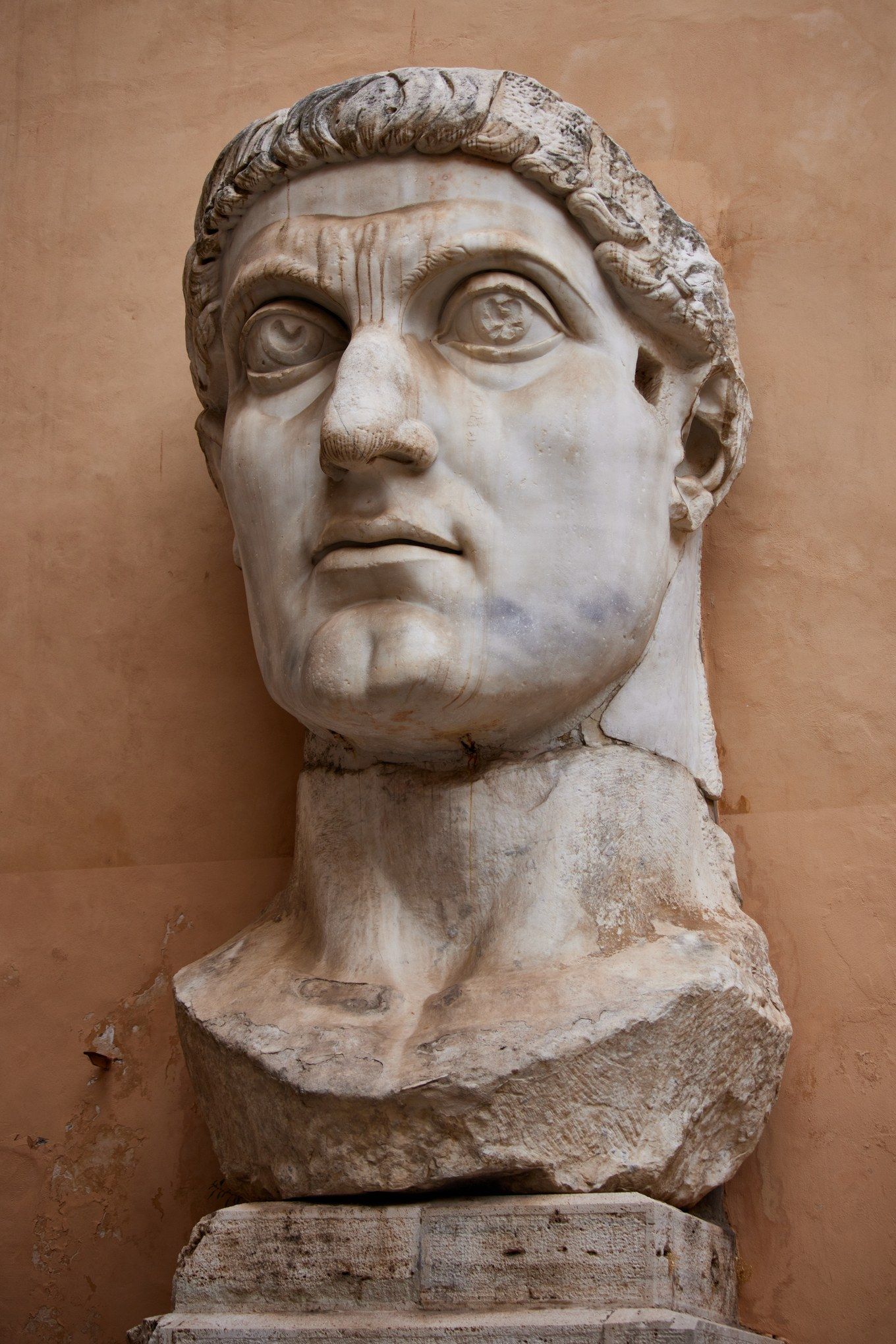
- Capitoline Museums: Colossal statue of Constantine — headAccessed 12 October 2026